The story behind NCSL 2026 — from NCERT and its library network, to the vision driving this year's conference.
The National Council of Educational Research and Training (NCERT), established in 1961, is an autonomous organization under the Ministry of Education, Government of India. NCERT, with its headquarters in New Delhi, plays a pivotal role in shaping and strengthening school education across the country. It assists and advises the Central and State Governments on educational policies and programmes, while leading initiatives in curriculum development, educational research, teacher education, and the creation of highquality learning resources, including textbooks and digital content.
As a key institution in India's educational framework, NCERT promotes innovation, excellence, and equity in education through initiatives such as the National Curriculum Framework (NCF) aligned with the National Education Policy (NEP). NCERT's academic and research activities are supported by a robust library network comprising the Central Library (Library and Documentation Division) at NCERT Headquarters, libraries at the Regional Institutes of Education (RIEs) in Ajmer, Bhopal, Bhubaneswar, Mysuru, Nellore, and Shillong, as well as specialized libraries at CIET, New Delhi and PSSCIVE, Bhopal.
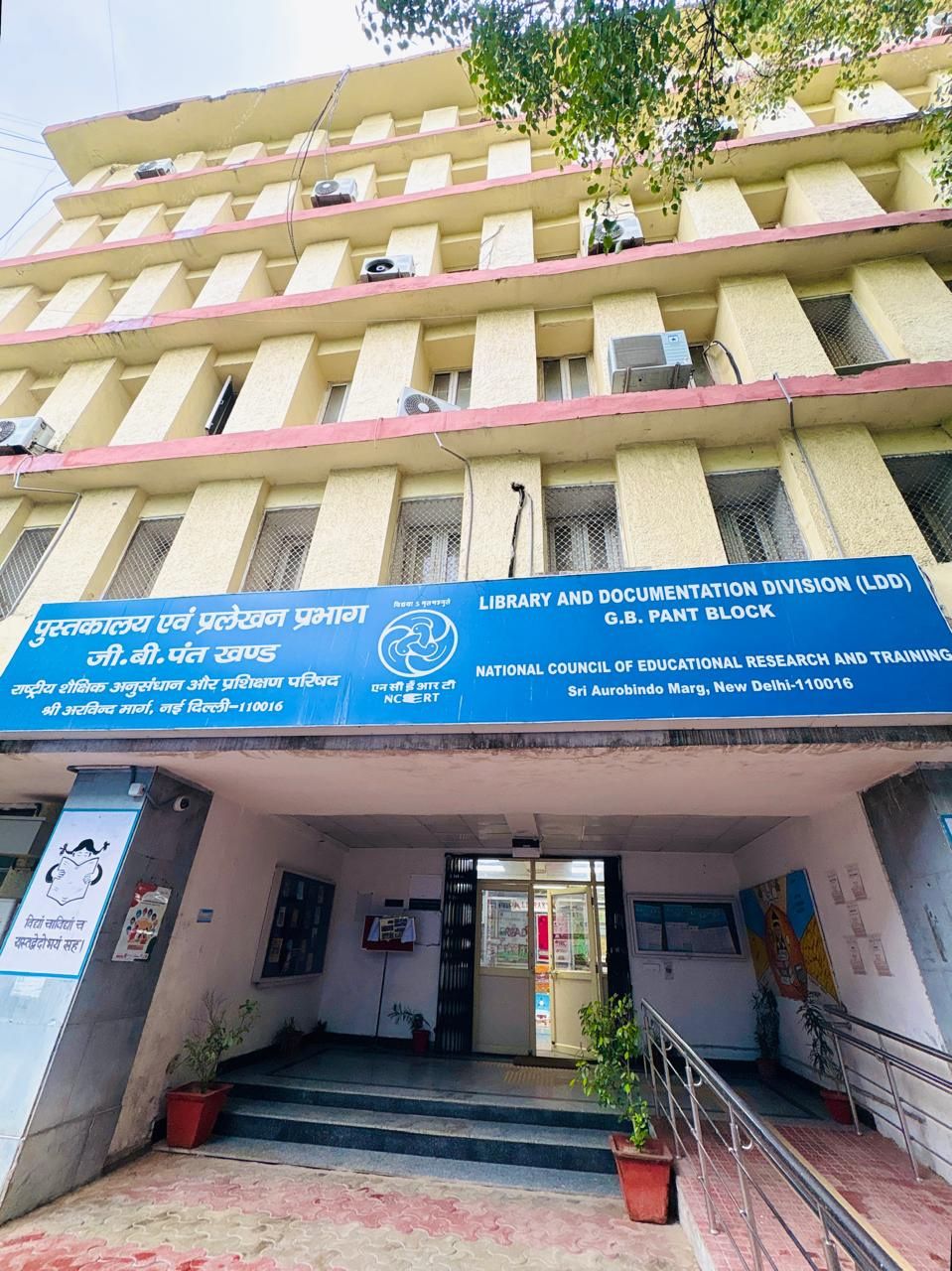
The Library and Documentation Division (LOO), NCERT is the central library and knowledge resource centre of the National Council of Educational Research and Training (NCERT), New Delhi. Established in 1961, the Division serves as a premier educational library supporting research, curriculum development, teacher education, policy formulation, and academic activities across the country.
With a rich and diverse collection of books, journals, reports, theses, NCERT publications, digital resources, and educational databases, LOO caters to the information needs of researchers, educators, students, librarians, and policymakers.
The Division offers a wide range of services, including reference and information services, circulation, current awareness services, access to eresources, Web-OPAC, institutional repository, and information literacy programmes. Through its innovative digital initiatives, professional development programmes, and commitment to excellence in library services, LOO promotes equitable access to knowledge, lifelong learning, research integrity, and the effective use of information in alignment with the vision of the National Education Policy (NEP) 2020.
The NCERT Library System is a nationwide network of libraries functioning under the National Council of Educational Research and Training (NCERT). It comprises the Library and Documentation Division (LOO), New Delhi, which serves as the apex library, along with the libraries of NCERT's constituent units, including the Regional Institutes of Education (Ajmer, Bhopal, Bhubaneswar, Mysuru, Nellore and Shillong), the Central Institute of Educational Technology (CIET) New Delhi, the Pandit Sunderlal Sharma Central Institute of Vocational Education (PSSCIVE) Bhopal, and other constituent centres. The system supports teaching, learning, research, curriculum development, teacher education, and educational policy through integrated access to print, digital, and multimedia resources.
In addition to its core academic and information services, the NCERT Library System plays a significant role in the development of school libraries and the professional growth of school librarians across India. Through national conferences, capacity- building programmes, training workshops, information literacy initiatives, and the dissemination of best practices, NCERT promotes innovative, inclusive, and sustainable school library services aligned with the vision of the National Education Policy (NEP) 2020 - contributing to a strengthened educational ecosystem and a culture of reading, inquiry, and lifelong learning.
“Aligned with the vision of the National Education Policy (NEP) 2020, the NCERT Library seeks to be a vibrant knowledge hub that supports teaching, learning, research, and innovation in education.”
The library is envisioned not merely as a repository of information but as a dynamic academic space that promotes reading, critical thinking, creativity, and lifelong learning. As an integral part of NCERT's educational and research ecosystem, it provides access to diverse print and digital resources, supports evidence-based scholarship, and facilitates the creation and dissemination of knowledge. Through its integrated library network, modern information services, and commitment to equitable access, the NCERT Library encourages intellectual growth, collaboration, and academic excellence while contributing to the broader goals of quality and inclusive education.
The two‑day conference is being organised with the following specific objectives:
To provide a national level platform for school librarians to present research papers, action research studies, and evidence‑based practices in school libraries.
To explore the role of school libraries in implementing the recommendations of NEP 2020, like foundational literacy, reading culture, critical thinking, and lifelong learning.
To provide a forum for exchange of ideas, experiences, and professional expertise among school librarians and library professionals from across the country.
To showcase innovative library initiatives, services, best practices, ICT implementations and successful models that enhanced student learning.
To provide opportunities for participants to exhibit their posters, projects, and innovative library practices in their schools.
To promote action research among school librarians for continuous improvement of library programmes, services, and resource utilization.
To encourage participants for adoption of technology‑enabled library services in schools.
To foster collaboration and networking among school librarians across the country.
As the apex academic body for school education in India, NCERT plays a pivotal role in guiding policy implementation, resource development, and capacity building. NCSL 2026 will reaffirm NCERT's leadership in implementing the vision of NEP 2020 by strengthening school libraries as nodal points of reading, literacy promotion, equitable digital access, civic engagement, and constitutional values.
The conference is expected to showcase innovative library practices, action research, and evidence‑based insights into the effective implementation of school library programmes across diverse educational settings. The conference proceedings will serve as a valuable reference resource for policymakers, educators, researchers, school librarians, and other stakeholders in education.
This conference will support the development of strong professional networks among the librarian fraternity and stakeholders of education — laying the foundation for sustained collaboration, knowledge‑sharing, and continued innovation in school library services across India.